information security
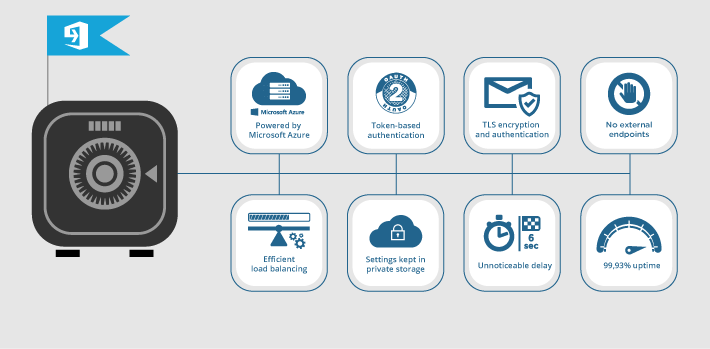
Are you interested in learning how a leading Office 365 software developer creates robust and flexible email solutions? Do you want to know how it is possible to combine top quality with absolute security? Szymon Szczęśniak, Business Development Director of CodeTwo, reveals a few facts about Microsoft Security from a Developer’s viewpoint in this article on Microsoft blog. This entry provides fellow developers with an insight on how to use powerful tools provided by Microsoft. It is also valuable from the Office 365 administrators' perspective, as it explains how CodeTwo ensures protection of their data.

Nowadays, most of us can hardly imagine living without using e-mail. Certainly, electronic mail has replaced traditional mail in many cases, becoming an efficient tool for communication and marketing. We use e-mail every day, starting from personal messages and finishing on purely business-related matters: job applications, subscriptions, reservations, transactions, promotional vouchers, invoices, on-line shopping, etc. A great number of important and confidential information flows from one inbox to another one and we can never be sure of its safety. Now, let's imagine a large company, where this number increases along with the series of promotional materials, newsletters, business offers, job enquires, clients complaints, support requests, inter-departments conversations and plain rubbish messages with no value for the company. How can we possibly manage such a mass of information and keep all the messages in order and properly secured? A smart email filter seems to be a perfect solution for this problem.
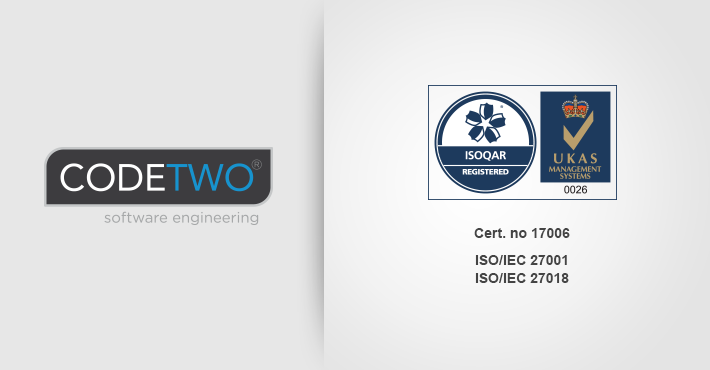
We are pleased to announce that CodeTwo’s comprehensive Information Security Management System (ISMS) has been officially certified against ISO/IEC 27001 and ISO/IEC 27018. The certificate proves that CodeTwo cares a great deal about data security. Our ISO-certified ISMS guarantees that we have the best measures in place to ensure information security and to protect your personal data both in the cloud and on-premises.