iphone

We've just updated CodeTwo Sync for iCloud - our blockbuster product for hassle-free synchronization of Outlook and iCloud folders (calendars, contacts, reminders/tasks). The new version brings back the meeting request sync feature that was blocked in the previous release due to iCloud resending invites to past events upon sychronization. We've also added support for Outlook 2013 and Windows 8. To update the program, simply download this version and install it on top of the exisiting installation. Your settings will remain unchanged. Thank you for all the comments, emails and phone calls regarding missing features. Without you, this program wouldn't be as killer as it is now. If you have more questions, ideas, or just want to send us your feedback, feel free to add your comment below. And for those of you who haven't heard about CodeTwo Sync for iCloud yet (is this still possible?), check out its website or the video here: Check out CodeTwo Sync for iCloud
Find out more about other synchronization tools for Outlook

CodeTwo Exchange Folders has been around for a while now, helping Android owners synchronize literally any Exchange calendar, contacts and tasks (public or personal) directly with their mobile phones. But so far the application was missing one crucial feature - compatibility with iOS devices. This lack did not go unnoticed. Hundreds of users from around the world sent us emails asking when they would be able to use the software to synchronize data between Exchange and their iPads, iPhones and iPods. What they didn’t know was that we were already developing a solution to meet their needs. The reason it took so long was because we wanted to get it just right.
And we did! The long awaited iOS compatible CodeTwo Exchange Folders (version 1.1.0) has just been released! You can download the new server module (Administration panel) directly from our website and the Mobile App from the Apple App Store or iTunes. To deploy the program you have to: Install the Administration panel on the Exchange Server and configure the synchronization service (more details here). NOTE: if you are already running the previous version (1.0.0), just install the new one (1.1.0) on top of it to update (all your settings and licensing information will be kept). Click here to learn more about how to update CodeTwo products. Install the Mobile Apps on mobile devices and connect them to your server. NOTE: if you are already running the previous version, just install the new one on top of it to update (all your settings and licensing information will be kept). Click here to learn more about how to update CodeTwo products. Select which Exchange folders will be available for synchronization (more details here). On the mobile devices choose which folders from Step 3 will be visible in the Mobile Apps (more details here). Here’s a list of benefits offered by CodeTwo Exchange Folders: Mobile access to contact, calendar and task folders located in all public and personal mailboxes on your company’s Microsoft Exchange Server. To ensure security all synchronized data are encrypted and travel directly between the mobile device and server (no Cloud storage) via a secure transfer tunnel opened by a TLS protocol and protected by Triple DES 168-bit encryption. Changes made either on a PC or Android/iOS device are synchronized in real-time and automatically. Your smartphones/tablets are updated wirelessly all the time via Wi-Fi or mobile Internet, regardless if you’re in your office or on the road. All HTML elements in calendar and task items (font formatting, tables, etc.) are synchronized to and from mobile devices intact. Reminders and meeting requests support. Administrator's control over access rights and settings. If you are not using CodeTwo Exchange Folders yet, make sure to give the free 30 day trial a go to see how it works. And if you have any questions related to the application, feel free to contact our Support team. Download CodeTwo Exchange Folders
CodeTwo Exchange Folders vs Exchange ActiveSync
Frequently asked questions

Many companies rely on Microsoft Exchange Server’s public folders to store shared data, archive documents and collaborate on projects. At the same time, the native capabilities of Exchange Server do not allow users to view Exchange public folders on mobile devices. This wouldn’t be a major issue, if not for the fact that smartphones, tablets and other handhelds are gradually replacing laptops and desktops as primary workplace devices. Luckily, CodeTwo has a solution: CodeTwo Exchange Sync. An application which allows you to automatically synchronize Exchange public folders with users’ personal mailboxes, making the public data instantly available on users’ mobile phones. Owing to this, Exchange tasks, contacts, calendars, and other outlook items, can be viewed and modified via devices running on iOS, Android, Windows Phone, or any other system supporting Active Sync protocol.
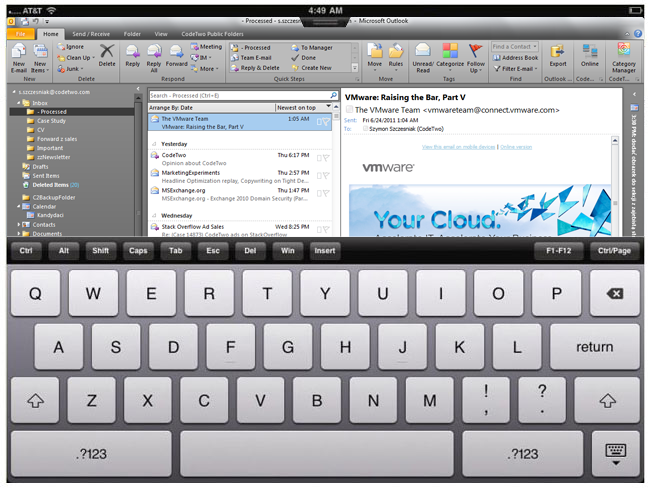
Since the world of tablets is getting bigger, better and more versatile, many of us (iPad aficionados and those who are now becoming ones) ask a question: Can I run Outlook on the Ipad? Well.. it would be a Sci-Fi question, if it wasn't for VMware View, thanks to which you can have Outlook displayed in the iPad or iPad 2 totally for free. VMware has finally made it possible to access your Windows Desktop from the iPad, which means you can not only display your favorite mail client there, but also use your tablet as a remote client of your desktop machine. If you don't want to use any remote desktop connections and want to simply synchronize your iPad with Outlook, you can do it pretty easily with the iCloud service and its iCloud Control Panel for Windows, which allows you to share Outlook data with iPad automatically. The iCloud-Outlook synchronization is, however, a little bit tricky as upon installing the control panel you get a new tree of folders in Outlook with your iCloud data. This has little to do with syncing as your master folders are still left intact. You can luckily fix this thanks to CodeTwo Sync for iCloud. See for yourself how easy it is: Learn more about CodeTwo Sync for iCloud and download it. © All rights reserved. No part or whole of this article may not be reproduced or published without prior permission.

If you're using Exchange Server to keep common company data bases (contacts, schedules, tasks , etc.), you will probably encounter a basic problem of companies similar to yours: How to pull this data out of public folders and replicate it to mobile devices of workers that work among your clients and business partners outside the office? You might be surprised with it, but this (any way you slice it) basic process can't be achieved just by using Exchange Server native capabilities. The ActiveSync service, which is responsible for syncing private folders with Windows Mobile handhelds, isn't capable of synchronizing public folders with them. In fact, the majority of mobile devices is only able to sync themselves with default folders of a desktop mail client. Normally, you will not be able to sync your mobile device with any additional personal folder. In other words, if you create e.g. Calendar No. 2 in your Outlook you will not be able to keep it in sync with your smartphone. Furthermore, it is not possible to sync data directly from Exchange Server public folders. How to solve this issue then? CodeTwo has the right solution for you. CodeTwo Exchange Sync is an application installed directly on the server that enables automatic synchronization of selected Microsoft Exchange Server folders. The program is extremely versatile in it's applications. The ability we're most interested in, is the synchronization of Exchange Server public folders (including contacts, tasks, calendars, mail etc.) with private mailboxes and (in the wake of it) with mobile devices your workers use to access them during their fieldwork. Take a look at the picture below which illustrates this process: In order to achieve this goal, the server administrator has to configure a simple synchronization rule using CodeTwo Exchange Sync that will force the replication of selected data stored in public folders to personal folders of any end user in the company network. Then, using the Exchange ActiveSync (EAS) service, the items pulled from the company data base to personal mailboxes can be easily synchronized with all mobile devices supporting the EAS protocol (Windows Mobile devices, iPhone, Blackberry, etc.). You can also use this mechanism analogically to replicate any data from any non-default folders of your mail client. In addition to this, by using different types of synchronization, such as One-Way or Two-Way, the administrator can decide which employees have the right to update personal folders via their smart phones and which are only authorized to view them. CodeTwo Exchange Sync is an easy-to-use, but yet extremely powerful application that will allow you to deploy completely new work-group scenarios in your company. The evaluation copy is free of charge and remains fully functional for 30 days. The program has been recently voted 2nd Runner-Up in MSExchange.org Reader's Choice pole organized by MSExchange.org in December 2010.
Read more about CodeTwo Exchange Sync
Download CodeTwo Exchange Sync 30-day trial
CodeTwo Home

CodeTwo Exchange Sync has been updated to version 2.2.0. The program enables an automatic, real-time synchronization of selected Exchange folders and allows users to access this data on their mobile devices, such as Blackberry, Android, iPhone, etc. The new version includes a number of important fixes and improvements, such as: Enhanced compatibility with Windows 7;
Better support for MAPI libraries in Outlook;
More convenient save folder location for log files - they are now saved in /ProgramData/ instead of the installation folder of CodeTwo Exchange Sync;
Synchronization process has been enabled or improved for:
- recurring files;
- items containing attachments, categories or "Subject" modifier; Recipients do not duplicate anymore;
Problem of Outlook profile changing automatically to C2ExchangeSyncAdmin profile after the installation of CodeTwo Exchange Sync has been eliminated;
An issue with opening message store has been fixed;
The mechanism of meeting requests' synchronization has been rebuilt to eliminate possible errors caused by this action. We advise all users of CodeTwo Exchange Sync to download and install the new version. This update is free of charge and can significantly enhance the program's efficiency, making your work with this application much more convenient. See a complete version history list for CodeTwo Exchange Sync.
Lear more about syncing your mobile with Public Folders of Exchange Server.
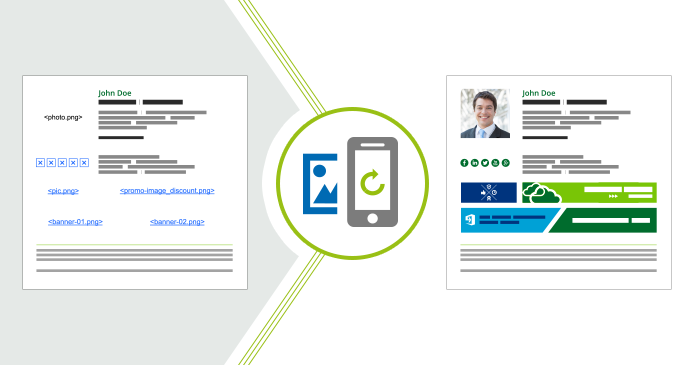
Do you use pictures in your emails? Most people do. Did you know that there is a problem you might face if you use iOS devices like iPhone or iPad? Whenever you reply to a message or forward it using such a native mail app, graphical elements such as pictures, logos or banners get deleted. That is a default behavior for iPhones and iPads, but there is a solution which works on Exchange Server. Why are images deleted from iPhone or iPad?
That is just the default behavior in native iOS mail app to delete images from email body when you reply to a message. It might be a way to declutter mailboxes and to save some space. Maybe it is designed that way because the original recipient has already seen the images. Although this might be found as perfectly logical, for some it is a twisted logic as it makes doing your job harder.

We wouldn't be ourselves if we hadn't fixed an issue with a 3rd party product and then shared it with the world. Many of our tools were initially created solely for our own needs, tested by us in a live environment as we grew from a small business to what we are now, and then turned into products that many of you use today. So... here we come with another tool for Outlook and iPhone/iPad aficionados. We've heard from our fellow users that the iCloud feature from Apple™, which is meant to synchronize Outlook with iCloud, iPhone, iPad and other iCloud-compatible devices, is a great tool but does not really sync the stuff that you already have in Outlook but creates another set of folders. To delve into the problem, we started using iCloud Control Panel together with Outlook for our own needs and soon we realized that our Outlook synchronization algorithms can quickly fix the issue. That's how we came up with this: CodeTwo Sync for iCloud enables you to automatically synchronize Microsoft Outlook folders with iCloud folders - the rest is in done by iCloud itself. The program will let you seamlessly synchronize Outlook calendar, tasks and contacts with your smartphone. And, as always, it's easier and faster than you can imagine. Just check it out for yourself:Learn more and download CodeTwo Sync for iCloudCodeTwo's Official Website
